


Case Study: The Hidden Costs of Painted Floor Lines (And Why 5S Facilities are Switching to Industrial Tape?

If you are implementing a 5S methodology in your warehouse or manufacturing facility, you already know that the floor is your foundation. "Set in Order" and "Standardize" rely heavily on visual cues—and nothing provides a clearer visual cue than your aisle markings and safety zones.
But what happens when those vital visual cues start to fade, scuff, and peel?
For many facilities, the default choice for floor marking has always been paint. It seems cheap and easy up front. However, as one UK distribution centre recently discovered, relying on painted lines in a high-traffic environment is a false economy that can cost tens of thousands of pounds in maintenance, downtime, and workplace injuries.
Here is a look at how upgrading to industrial-grade rubber marking tape transformed their safety record and their bottom line.
The Challenge: The Fading Illusion of Safety
Apex Logistics operates a bustling 2,000m² distribution centre. Like many 5S-driven operations, they rely on strict color-coding to separate heavy forklift traffic from pedestrian zones and to highlight hazardous areas.
For years, Apex used standard industrial paint for their floor lines. The problem? Paint simply cannot survive the extreme stress of warehouse operations. Under the constant lateral shear of forklift tyres and heavy pallet loads, the painted lines scuffed, chipped, and wore away rapidly—especially in turning zones.
Within just two years, the bright black&yellow hazard zones and blue pedestrian crosswalks were barely visible.
The resulting costs were two-fold:
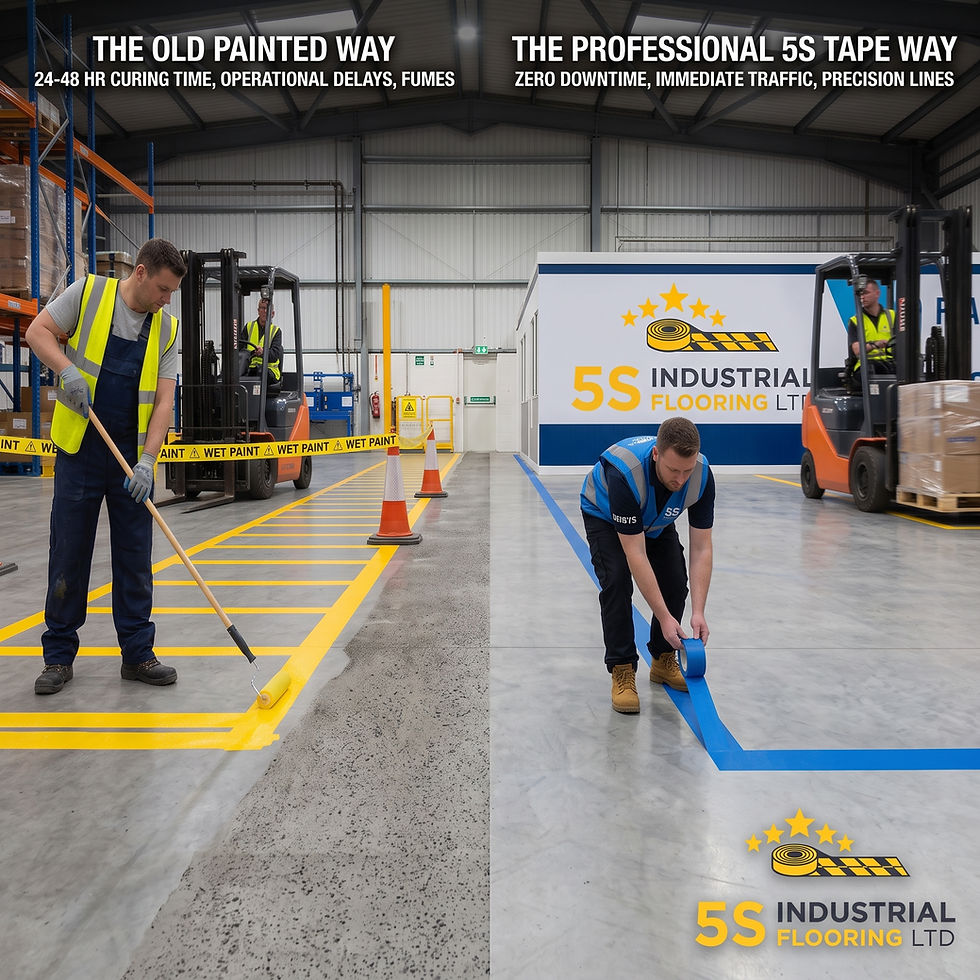
The Maintenance Drain: Repainting meant cordoning off active warehouse zones, enduring 24 to 48 hours of curing downtime, and paying for continuous touch-ups.
The Safety Crisis: Faded lines blur the boundaries between people and machines. In one year, Apex recorded three reportable slip, trip, and fall incidents linked directly to poor floor visibility and the surprisingly slick surface of worn painted zones.
The True Cost of Warehouse Incidents
Workplace accidents are devastating to team morale, but they also carry a massive financial burden. According to HSE statistics, the cost breakdown for Apex Logistics was severe:
Average Cost per Incident: A typical slip or trip injury costs a business between £8,000 and £15,000 in direct and indirect costs (including sick pay, lost productivity, and administrative burdens).
Total Annual Loss: Apex’s three incidents cost the company approximately £30,000 in a single year, alongside the threat of increased insurance premiums.
The 5S Solution: Upgrading to Industrial Rubber Marking Tape
Realizing that paint was compromising their 5S standards, Apex’s operations team decided to overhaul their traffic management system. They invested £4,500 in industrial-grade rubber safety aisle marking strips (75mm width).
They utilized standard 5S color coding:Blue strips for pedestrian walkways and Yellow , black & yellow for forklift routes and hazard boundaries.
Paint vs. Industrial Rubber Tape: The Breakdown
While the initial material cost of the rubber tape was higher than buckets of paint, the operational comparison wasn't even close:
Feature | Painted Markings | Industrial Rubber Marking Tape |
Durability | 2-5 years (fails quickly under forklifts) | 15-20 years (withstands turning forces) |
Operational Downtime | 24-48 hours cure time per application | Zero downtime (immediate use after laying) |
Lifecycle Cost | High (constant labor, repainting, and downtime) | Low (one-time installation, minimal maintenance) |
5S Flexibility | Difficult to change (requires scraping/grinding) | Adaptable (can be lifted and repositioned for layout changes) |

The ROI: A Safer, Leaner Floor
The impact of the switch was immediate. By replacing paint with highly visible, tactile, and durable industrial rubber tape, Apex established permanent segregation between pedestrians and machinery.
The First-Year Results:
Incidents Reduced to Zero: Clearer boundaries eliminated the slip, trip, and fall incidents, saving the business £30,000 annually.
Maintenance Eliminated: No more weekend shutdowns waiting for paint to dry.
Massive ROI: The initial £4,500 investment yielded an immediate return by eliminating both the accident costs and the recurring maintenance budgets.
Is Paint Ruining Your 5S Standards?
If you find yourself constantly repainting your warehouse floors, or if faded lines are putting your team at risk, it is time to rethink your foundation. Industrial-grade rubber marking strips offer the durability, visibility, and flexibility that lean manufacturing and 5S methodologies demand.
Ready to stop painting and start standardizing?
Explore our range of 5S-compliant industrial flooring and heavy-duty aisle marking tapes today, and build a warehouse floor that lasts.


Comments